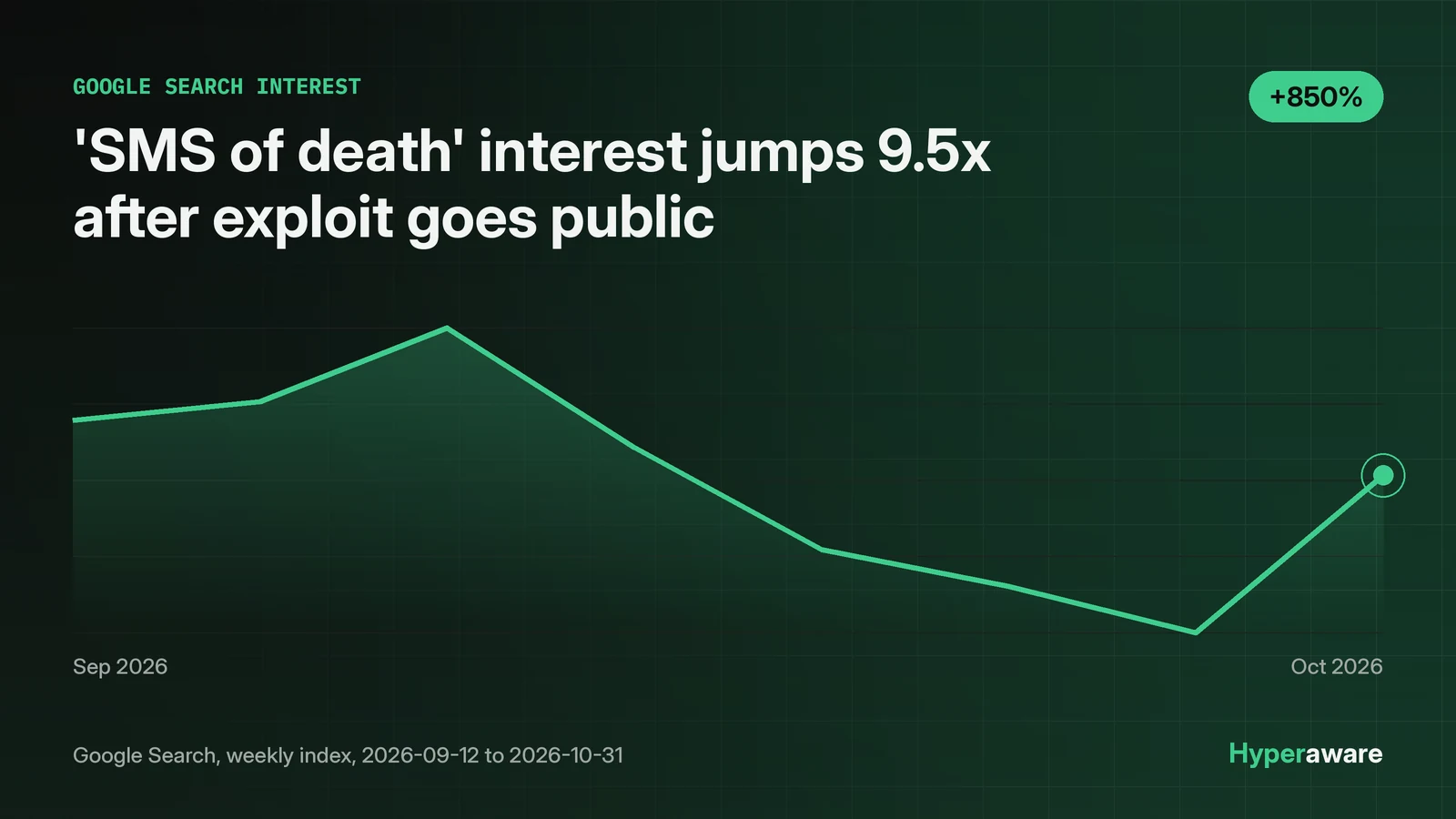
Search interest in "SMS of death" was nearly dead by late October: the Google Search index sat at 2 in the week of October 24. Then the exploit went public, and interest rebounded 9.5x to 19 in the week of October 31. The surge is easy to explain: a working proof-of-concept exploit for the zero-click flaw dropped on October 29, and BleepingComputer covered it on October 31. This is why it's trending.
The attention trail
The timeline reads like a textbook disclosure cycle. A technical write-up and proof-of-concept exploit were published at smsofdeath.com on October 29, an r/Android thread the same day drew 600 upvotes and 65 comments at 96% upvoted, and BleepingComputer's report on October 31 pushed the story onto this site's news board. Google Search interest had peaked around September 26 (index 35) and faded steadily. The fresh disclosure restarted the curve. Neither the researcher nor BleepingComputer reports any in-the-wild exploitation.
What the flaw does
CVE-2026-58882, dubbed "SMS of Death," is a zero-click denial-of-service flaw in how Android handles WAP Push messages, according to BleepingComputer's report, which draws on the researcher's published analysis. A single malformed eight-byte SMS sent to port 2948 can crash the phone process that manages cellular functions. Calls drop, including calls to emergency services, and the victim never sees the message, because Android processes it before it reaches the inbox.
The researcher, Mark Blah, found that repeated messages make it worse: in his testing, 20 malicious messages could trap a phone in a reboot loop, and one Android 12 device restarted into recovery mode roughly every 90 seconds, needing a factory reset to recover.
Who is still exposed
Per the researcher, Google patched the flaw in its October 2026 Android security update for Android 14 through 17, though the fix reportedly does not appear in Google's October security bulletin. Android 12 and 13 devices did not receive the fix and remain vulnerable. Android updates generally install automatically on supported devices, but availability depends on the manufacturer and carrier.
What to do
Check the security update level on your Android phone: the October 2026 patch closes the hole on Android 14 and newer. If your phone runs Android 12 or 13 and is no longer getting updates, it has no fix coming. That device is the one this exploit was built for. The flaw crashes phones; nothing in the reporting says it steals data.
More fast explainers on why topics are trending: Hyperaware news.