On November 20, Anthropic mathematician Levent Alpöge announced that he believed he and the company's Claude chatbot had proved the Riemann hypothesis, the 1859 problem about prime numbers that carries a $1 million prize. On November 21, the Lean Focused Research Organization and the Mathlib Initiative said they had independently verified the proof, expressing full confidence in its correctness. The Clay Mathematics Institute still lists the problem as unsolved, and its prize rules need publication, two years, and general acceptance. On November 22, "riemann hypothesis" ranked 21st on Google Trends and 2nd on Wikipedia Trending.
The claim landed Friday, the check came Saturday
Alpöge posted a four-page note on his website on November 20, writing, "I believe I have, working with Claude, discovered a proof of the Riemann Hypothesis," USA Today reported. He said he had worked with Claude for about six weeks to develop the proof, and credited the model with pulling ahead near the end: he and Claude had a great time working together in recent months, but "Claude far outpaced me near the finish line." The proof was released as computer code in Lean, a programming language that checks each step of a mathematical argument, published across 14 archive parts, per eWeek. Alpöge said the work also establishes the Generalized Riemann Hypothesis, USA Today reported.
The check arrived the next day. On November 21, the Lean Focused Research Organization and the Mathlib Initiative announced they had independently verified the proof using mathematical software, USA Today reported. They said they had checked that Alpöge's code proved the correct mathematical statement and that multiple independent checking systems accepted the proof. Andrew Sutherland, a mathematician at MIT, independently compiled the result in Lean and called it a historic moment, Scientific American reported.
In August, an experimental version of Claude improved a longstanding result on the zeta function, raising the proven lower bound on the share of zeros on the critical line from 41.6% to 67.2%, eWeek reported.
A rival proof appeared the same day
Alpöge's was not the only claim. On the same day, a separate study claiming to have proven the Riemann hypothesis also emerged, and this one is entirely human written, Nature reported. The preprint was written by Alessandro Maria Masullo, a mathematician who received his PhD at Stanford in 2020, and posted online by Ravi Vakil, a mathematician at Stanford. Vakil described the post as a hurried announcement: the plan had been for Brian Conrad to work with Masullo for a year to polish the writing, then announce it after running it by enough people.
Two claims on one day does not make either one right. It means the checking now runs in parallel, and the community has two drafts to pick apart instead of one.
What counts as a solution
A claim counts as a solution only when the mathematics is understood and the Clay Mathematics Institute's slow prize process runs its course. Bernhard Riemann proposed the hypothesis in 1859. In 2026, the problem turns 167 years old, and Riemann himself was born 200 years ago this September, per Nature. It concerns the distribution of prime numbers. In technical terms, it says all the nontrivial zeros of the Riemann zeta function lie on a particular vertical line in the complex plane, with real part equal to one-half, eWeek explained.
It is one of the seven Millennium Prize Problems selected by the Clay Mathematics Institute, which offers a $1 million prize for a correct solution to each, USA Today reported. The prize follows a much slower process than the verification: the institute's rules require publication in a qualifying outlet, at least two years after publication, and general acceptance by the global mathematics community before it will consider a proposed solution, per eWeek. If the proof is correct and understood, Hector Pasten, a mathematician at the Pontifical Catholic University of Chile, said it completes a dictionary between different branches of math, "something like a Rosetta Stone," Scientific American reported. As Scientific American noted, the result has no immediate real-world applications: it will not upend global banking or make the internet run faster.
The timing drew questions
The announcement came a day after Anthropic's record-breaking debut on the stock market, Scientific American reported. The IPO initially valued the company at $1.5 trillion, but the company's valuation dropped on November 19, per Nature. Andrew Granville, a number theorist at the University of Montreal, said Alpöge should have taken the time to prepare a clearer write-up before announcing, called the released document garbled, and cited the downturn in the company's stock value as the reason for the timing. Alpöge answered that directly in his note: "There is an obvious cynical view, to do with the timing, but it is false," Nature reported.
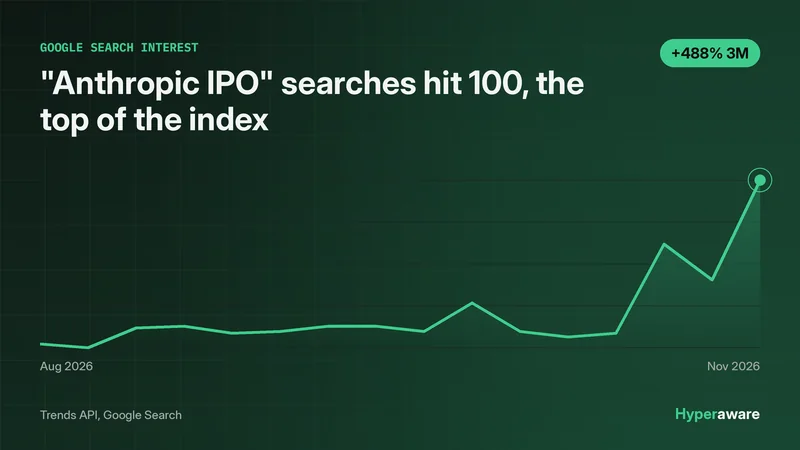
James Maynard, a Fields Medal winner at Oxford, said, "If this fully checks out, it is clearly a historic milestone in mathematics," Nature reported. Tristan Buckmaster, a mathematician at New York University, said the proof is crazily complicated and it will take a long time for mathematicians to digest, Nature reported. Alpöge himself is candid about not having mastered all the territory in the argument, and intends to understand it more fully and produce a proper written account, eWeek reported. The Anthropic IPO piece covers the debut that preceded the announcement by a day.
The attention data: flat for years, then No. 2 on Wikipedia
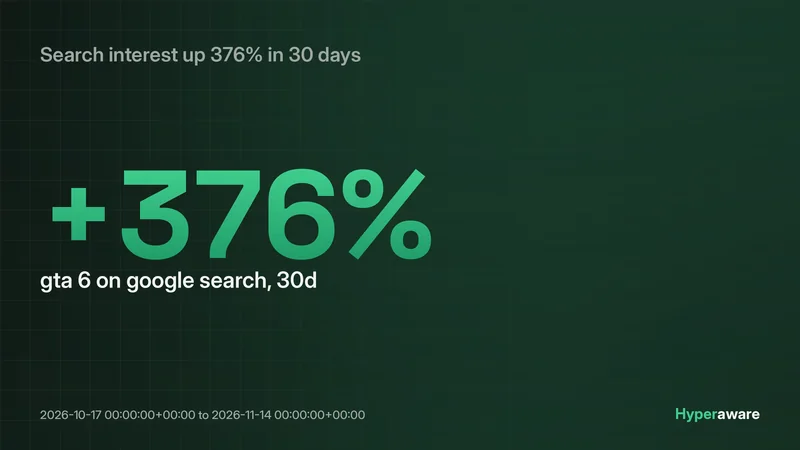
The search record shows almost no attention for years, then a No. 2 Wikipedia rank on November 22. Weekly Google Search interest in "riemann hypothesis" sat at 1 or 2 for most of the last five years, with a peak of 15 in the week of September 19, 2026, and a last measured value of 1 in the week ending November 14. The series ends six days before the announcement, so it says nothing about search after November 20. What it does say is that the problem drew almost no search attention for years, then reached 2nd on Wikipedia Trending and 21st on Google Trends on November 22, with "anthropic stock" at No. 3 on the Google board. On Wikipedia it climbed from No. 3 on November 21 to No. 2 on November 22, ahead of Ramayana: Part 1 and behind only Grand Theft Auto VI. The Hunger Games prequel held No. 4 on Wikipedia on November 22.
A proof claim is not a proof until the mathematics is understood, and a board rank is not a verdict. But a 167-year-old problem that barely registered in search now sits near the top of the page-view charts, next to a video game launch. That is the attention the claim earned in two days.