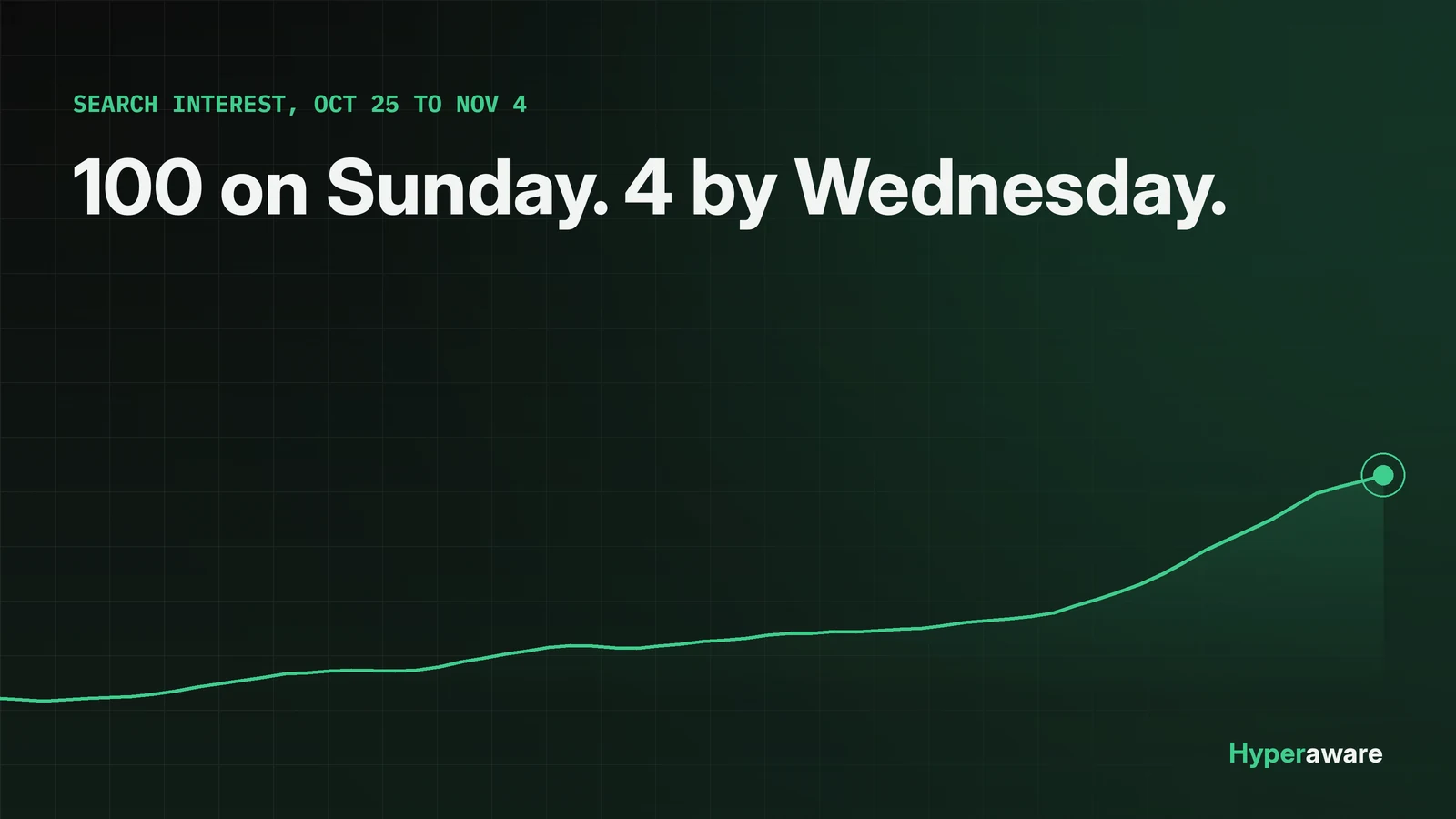
Daylight saving time ended in the United States on Sunday, November 1, when clocks fell back an hour. Search interest in the phrase hit 100, the top of the scale, that day, then dropped to 21 on Monday, 7 on Tuesday and 4 by Wednesday. Europe's change a week earlier, on October 25, produced a peak of 94. The shape is the story: a one-day question spike, answered and forgotten within three days, not a lasting trend.
Europe peaked first, a week earlier, at 94
Europe's clocks changed on Sunday, October 25, according to timeanddate.com, and search interest in daylight saving time jumped to 94 that day. The four days after read 33, 23, 14 and 15, the same fast fade the American change would repeat a week later. Two changes, seven days apart, produced two peaks, and the American one ran higher.
The American peak lasted a single day
Search interest hit 100 on Sunday, November 1, the day US clocks fell back, after readings of 30 on October 30 and 52 on October 31. Then it fell hard: 21 on November 2, 7 on November 3, 4 on November 4. The drop from peak to 4 took three days. Outside the two change weekends, October 1 to 24 readings sat between 3 and 13, but September broke that pattern, with 51 on September 20 and 45 on September 26, for reasons the data does not explain.
September had a spike no clock change explains
Search interest rose to 30 on September 19, 51 on September 20 and 39 on September 21, then reached 45 on September 26. No clock change falls on those dates. The data does not say why interest rose then.
The coverage asked whether this is the last year
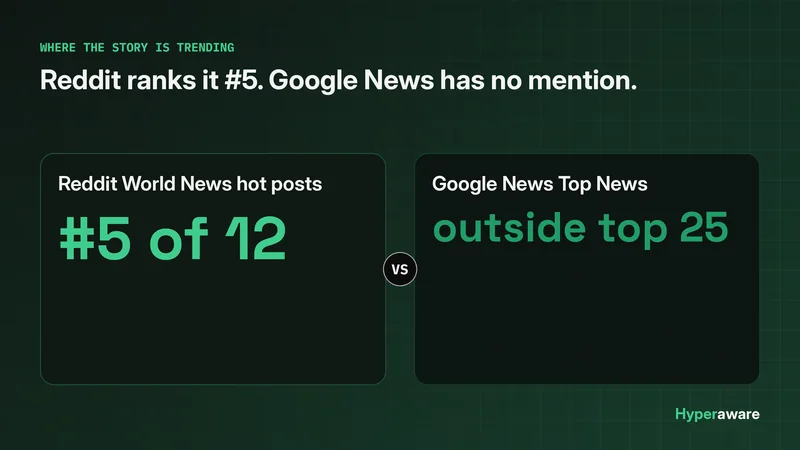
The Tacoma News Tribune asked the question outright in its October 29 headline, wondering whether this is the last year clocks change. NBC News ran a straight explainer, "Daylight saving time ends Sunday. Here's what to know as clocks 'fall back,'" and the Detroit Free Press asked, "Is this finally the weekend to turn clocks back?" Seven outlets carried the story in the top news cluster, including CNET, Greenville Online, NBC 7 San Diego and USA Today.
Spring peaked on the weekly measure, autumn on the daily one
Zoom out to the weekly series and the picture changes. Across 261 weekly readings to October 24, the highest weeks were 44.0 for the week of March 14, 2026, and 39.0 for the week of March 7, the spring change. The weekly series is normalised separately from the daily series, so a weekly 44.0 cannot be compared directly with a daily 100. Weekly averages smooth out a one-day spike, so the spring change leads on the weekly measure while autumn leads on the daily one. Both series agree on the shape: interest gathers for a few days around the change, then drains away. The September readings are the one gap in that picture: interest did rise between changes, and this piece cannot say why.
The question comes back in March
Daylight saving time returns on Sunday, March 14, 2027, the second Sunday in March, according to timeanddate.com. If the pattern repeats, the same spike will come with it: a few days of questions, a one-day peak, then quiet. The broader phrase 'daylight saving time' draws 673,000 monthly searches, so the audience for the next answer is already there. The search-interest numbers behind this piece come from the site's Google Trends board, and the story cluster sits on the Google News board.