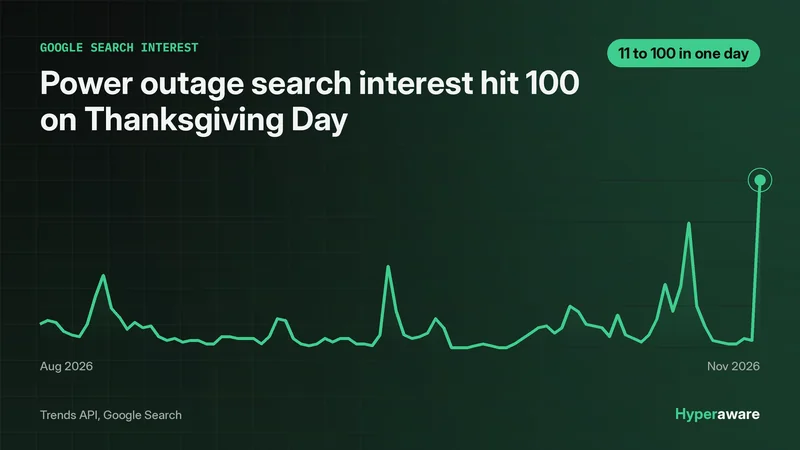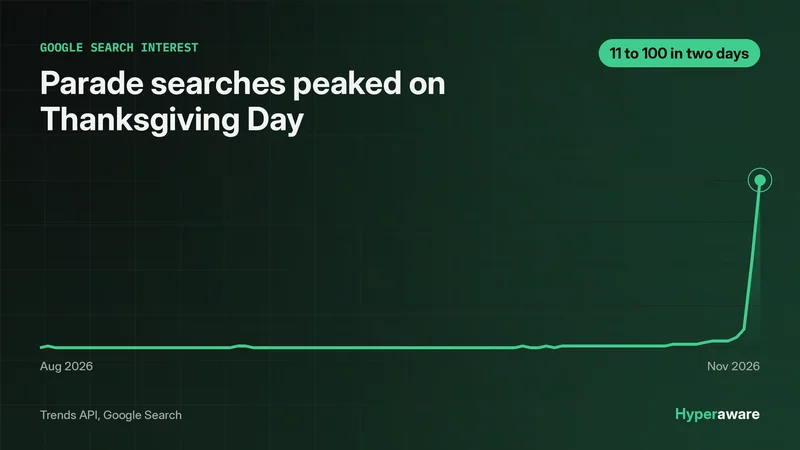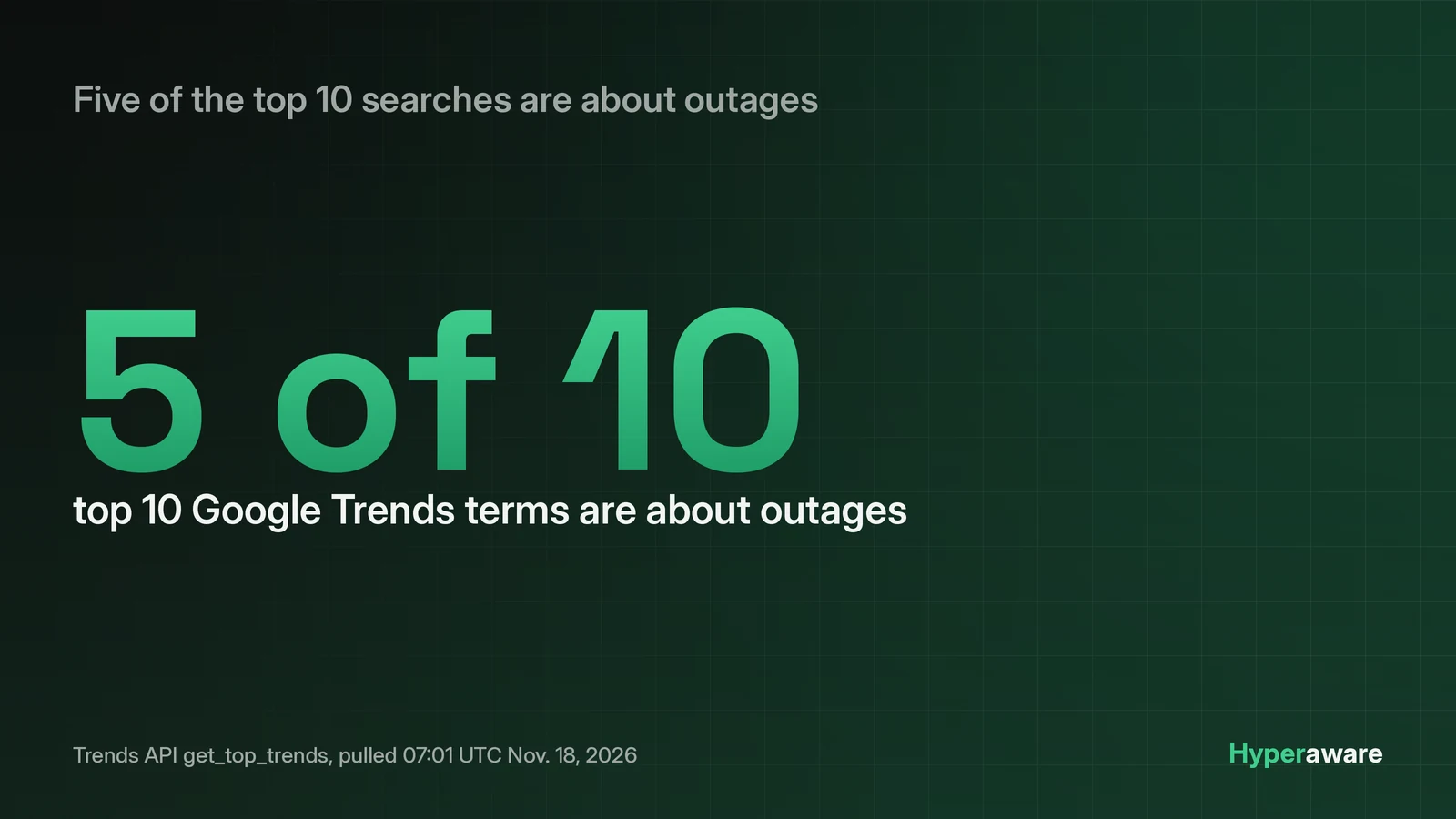
Five of the top 10 Google Trends terms on Wednesday morning, Nov. 18, are about outages: the FAA at No. 1, Outlook at No. 2, Microsoft at No. 4, Chase at No. 8 and grounded flights at No. 9. The failures behind them are separate. Microsoft traced its Nov. 12 outage to a software defect introduced in July. Chase blamed a software bug for slowed transactions on Nov. 16. The FAA preliminarily blamed a router flood for its Nov. 13 ground stop. No official has established a common cause, and no operator blames a cyberattack. The seventh term, blackout, is a false rumor, not a real outage.
The search board reads like an incident log
Five of the Google Trends top 10 terms name an outage; a sixth, outages, sits at No. 15. Hyperaware pulled the board at 07:01 UTC on Wednesday, Nov. 18.
| Rank | Term |
|---|---|
| 1 | faa |
| 2 | outlook outage |
| 4 | microsoft outage |
| 8 | chase bank |
| 9 | flights grounded |
| 15 | outages |
The terms map onto four incidents in five days: Microsoft on Nov. 12, the FAA on Nov. 13, Chase and United on Nov. 16, with "flights grounded" covering both aviation failures. Robert Pattinson sits at No. 3 on Bond casting reports; a question about the GTA 6 release time is No. 5. On X, the board pulled about 28 hours earlier had United Airlines at No. 5.
Microsoft traced its outage to a fix from July
Microsoft's preliminary report, published Nov. 15, traces the outage to a fix deployed in July. Executive vice president Charles Lamanna posted an abridged version on X on Monday, The Register reports. Three factors combined. A latent defect made the gateway servers become overwhelmed and unresponsive under certain load conditions. The defect came from a fix prepared for those gateway servers, deployed from July. It ran worldwide for more than three months without observed impact.
Second, about 15 hours before the outage, Teams shifted to the primary gateway shared with Exchange Online. Third, almost 14 percent of gateway capacity was out because of an unrelated issue from the previous day. Together, the higher load and reduced capacity hit the latent bug, requests built up until servers stopped responding. At the lowest point, more than 80 percent of servers were unresponsive.
Microsoft's timeline puts the first support case at 16:33 UTC on Nov. 12. Engineers identified connection negotiation as the main culprit by 00:30 UTC on Nov. 13 and applied a mitigation that reverted the defective change, with services healthy at 16:10 UTC on Nov. 13. Microsoft said the outage showed no sign of malicious or cyber activity, Gadgets360 reports. The full post-incident report is due Nov. 20.
Chase called it a software bug
On Monday, Nov. 16, a software bug in JPMorgan Chase's on-premises hardware slowed transactions, the bank said. Downdetector showed about 4,800 Chase reports around 2 p.m. ET; reports also spiked for Bank of America, Wells Fargo, U.S. Bank and Zelle, USA TODAY reports.
Chase said the issue was technical, not a cyberattack, and not systemic: other banks felt it only through transactions with Chase. Customers could still reach their accounts and funds, the bank said, and by about 7 p.m. ET it told USA TODAY transactions were being processed normally.
Zelle itself was not down. Early Warning Services, which operates Zelle, said the network was fully operational, and U.S. Bank said its systems were not directly affected, the Associated Press reports.
Two aviation failures, three days apart, one explained and one not
The FAA halted every U.S. departure on Friday, Nov. 13, and the Department of Transportation confirmed departures could resume at 8:15 p.m. EST, Airways Magazine reports. Transportation Secretary Sean Duffy said on Nov. 14 that L3Harris was switching a remote site from copper to fiber when a router in the changeover began flooding other routers. The FAA's Nov. 15 update named El Dorado, Arkansas, and Amarillo, Texas, as two potential sources, and said the network received about 1,000 connection attempts every four to five seconds. Instability reached 17 of the FAA's 22 en route centers. Blocking the two sites stabilized the network, and a broadcasting function on new routers was disabled. The investigation continues; Duffy's account is preliminary.
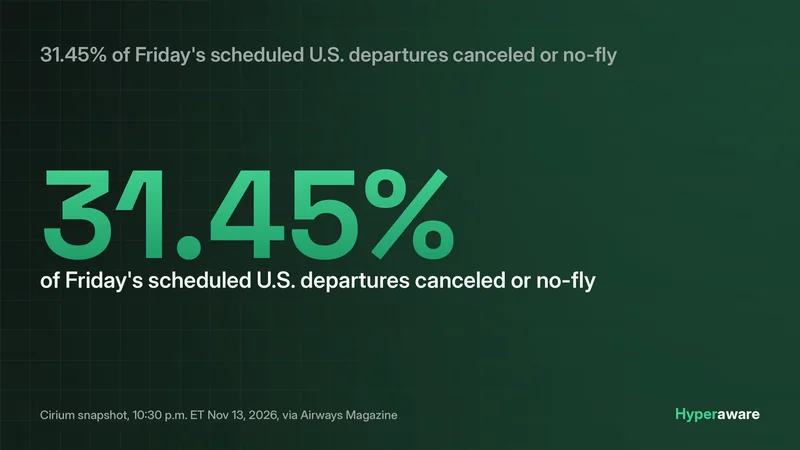
Cirium's updated snapshot, supplied to Airways on Nov. 16, counts 9,079 of 26,284 scheduled U.S. departures on Nov. 13 as canceled or no-fly, 34.54 percent. Across Nov. 13 to 16, the combined figure is 18,400 of 100,284 departures, 18.35 percent. The Nov. 16 count is a morning snapshot, so the total is provisional. The combined category counts canceled flights plus flights not departed within 180 minutes of schedule, so it is not cancellations alone; unrelated cancellations may be included. Hyperaware's FAA ground stop piece used an earlier snapshot, 31.45 percent; the updated count supersedes it.
United's failure came Monday afternoon and was separate. The airline said it resolved a technology issue around 6 p.m. ET that had delayed departures for about 90 minutes, with no impact on flights already in the air or on United Express flights, and no indication of a cybersecurity issue, Reuters reports. A pilots union memo seen by Reuters said a companywide web-based outage had hit pilot-facing applications, including crew communications, and the airline could not provide aircraft weights. FlightAware counted 645 United flights delayed, 20 percent of the schedule, and 25 canceled as of 6:50 p.m. ET. The airline has not said what caused the outage. Duffy said it was "not an FAA system-wide problem."
No common cause has been found
Three operators have given internal causes: a July gateway fix at Microsoft, a router flood at the FAA, a software bug at Chase. United has not said what caused its outage. No operator or investigator has tied the incidents together with evidence.
DHS Secretary Markwayne Mullin said Monday night that his investigators do not believe a cyberattack caused the outages, USA TODAY reports. Mullin also floated a different theory: the outages may have been caused by a malfunction brought on by incorporating artificial intelligence into existing infrastructure, without pointing to evidence.
The blackout searches point at a rumor, not a blackout
"Blackout" at No. 7 is the odd term out, driven by viral posts claiming a 90-day nationwide blackout begins Nov. 17, tied to a FEMA alert test and a 2023 Simpsons clip.
What is actually scheduled is a nationwide test of the Emergency Alert System, run by FEMA with the FCC: about one minute on radio and television at 2:20 p.m. ET, carrying the message "This is only a test. No action is required by the public." The FCC announced it on Sept. 16, with Dec. 3 as the backup date. It touches neither the power grid nor mobile phones. No federal agency, utility or grid operator has announced one, a St. Louis newsroom found.
Nov. 17 has passed, and the only scheduled event was the one-minute test. The rumor outlived its deadline: blackout is still seventh on Google the morning after.