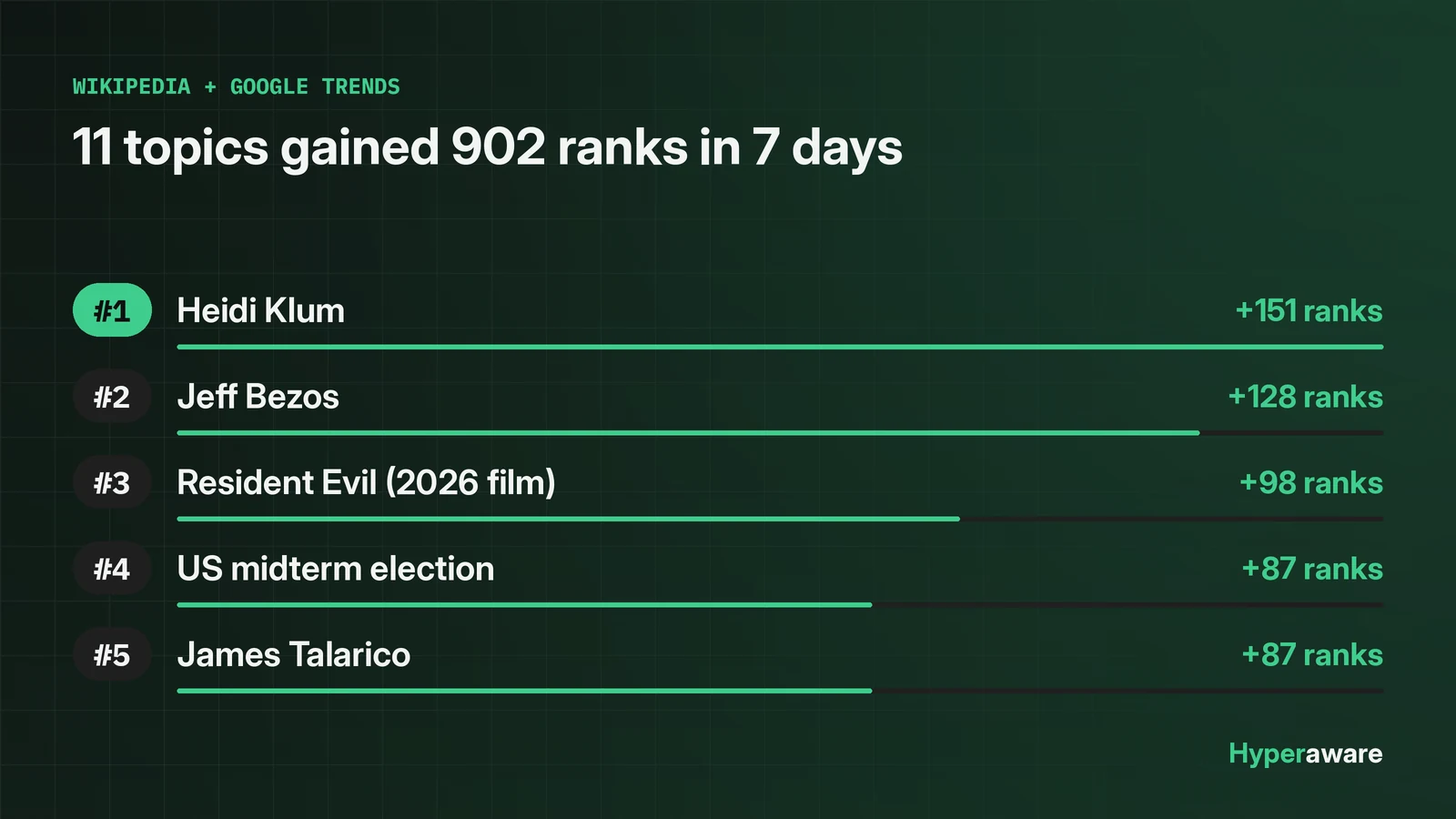
Eleven topics gained a combined 902 ranks in seven days across the Wikipedia Trending and Google Trends boards, and every one of them traces to a scheduled event, a news story, or a product launch. Heidi Klum led with 151 ranks gained after her October 31 Halloween reveal; Jeff Bezos followed with 128 on news of his AI startup's San Francisco expansion; and Zach Cregger's Resident Evil gained 98 ahead of its November 3 digital release. Hyperaware defines velocity as ranks gained per day over a fixed 7-day window, which puts Klum at 21.6 and the average top-11 riser at 12.0. Scheduled events drove five spikes, news events three, and product launches three; none of the top 11 rose organically. Six other boards produced zero climbers: three turned over completely in the same week, and on the other three every current item held or fell.
Method: velocity means ranks gained per day over a fixed 7-day window
Velocity in this report means exactly one thing: ranks gained per day, computed as rank change divided by 7.
The window runs from the October 27 snapshot to the November 3, 2026 snapshot taken at 09:01 UTC. Nine boards were tested for rank change over that window: Wikipedia Trending, Google Trends, Google News Top News, Reddit World News, X (Twitter) Trending, YouTube Trending, TikTok Trending Searches, Reddit Hot Posts, and Polymarket Top Markets. Only two boards, Wikipedia and Google Trends, returned computable rank changes. Six boards returned zero climbers, either because the board turned over completely or because every current item held or fell. Polymarket had no snapshots, so it produced nothing.
Triggers fall into four classes. A scheduled event was on the calendar before the week began: an election, a holiday party, a weekly episode. A news event was unplanned coverage: a lease signing, a casting rumor, a championship. A product launch was a release or rollout: a film hitting digital, an app update. Organic means no identifiable trigger could be found in the November 1-3 coverage. The classification is judgment applied after the numbers, not something the API measures.
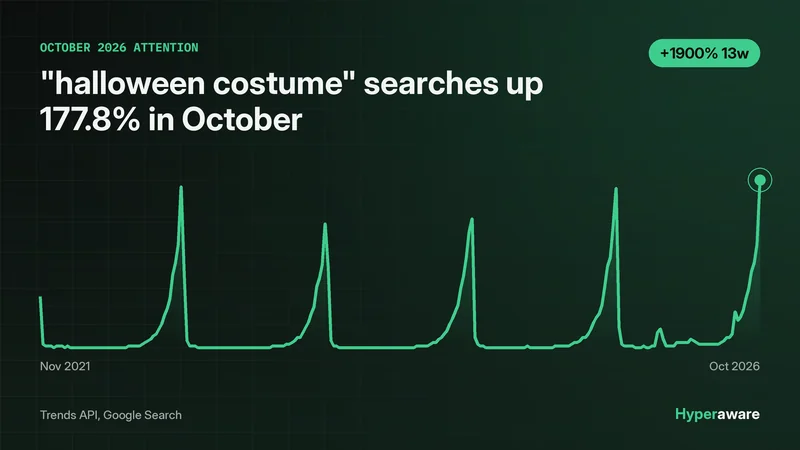
The data shows 25 climbers on Wikipedia and exactly 1 on Google Trends. That split suggests the two boards capture different curiosity: Wikipedia measures people researching something they just heard about, while the Google Trends board surfaced a single search spike for a Halloween costume. Every figure in this report comes from the November 3 tool pulls and lives in the accompanying data file.
The 11 fastest risers gained 902 ranks in 7 days
The 11 fastest-rising topics gained 902 ranks between October 27 and November 3, an average of 82 ranks each.
| Topic | Rank Nov 3 | Rank Oct 27 | Ranks gained | Velocity (ranks/day) | Trigger |
|---|---|---|---|---|---|
| Heidi Klum | 9 | 160 | 151 | 21.6 | scheduled event |
| Jeff Bezos | 46 | 174 | 128 | 18.3 | news event |
| Resident Evil (2026 film) | 83 | 181 | 98 | 14.0 | product launch |
| United States midterm election | 13 | 100 | 87 | 12.4 | scheduled event |
| James Talarico | 40 | 127 | 87 | 12.4 | scheduled event |
| Callum Turner | 86 | 164 | 78 | 11.1 | news event |
| 101 | 175 | 74 | 10.6 | product launch | |
| Ramayana: Part 1 | 43 | 97 | 54 | 7.7 | product launch |
| Bigg Boss (Hindi TV series) season 20 | 127 | 177 | 50 | 7.1 | scheduled event |
| Kimi Antonelli | 6 | 55 | 49 | 7.0 | news event |
| MobLand | 92 | 138 | 46 | 6.6 | scheduled event |
Klum accounted for 16.7 percent of the total gain by herself, the only topic moving at more than 20 ranks a day. Next to the pure rankings, two clusters stand out in the attention data. Election pages occupy 4 of the top 25 Wikipedia climbers: the midterm election page, Talarico, Donald Trump at plus 37, and the 2026 Israeli legislative election. Film and television pages occupy another heavy block: Resident Evil, Ramayana, Bigg Boss, MobLand, Obsession, and Backrooms. The split mirrors how the week actually felt: one country voting, one champion crowned, and a stack of releases landing within days of each other. Readers following the Wikipedia trending board saw these climb in real time.
Scheduled events produced 5 of the 11 spikes
Five of the 11 spikes trace to dates that were on the calendar long before the week began.
Heidi Klum's 151-rank climb is the cleanest example of a scheduled event converting to attention. She revealed a giant severed-hand costume at her 25th annual Halloween party on October 31 at Cathédrale in New York, a look she built over 4 months with makeup artist Mike Marino, as PEOPLE reported. The costume had been teased for a week, the party landed on a fixed date, and the Google Trends board registered the single biggest 7-day move in the whole study. Scheduled, teased, revealed: the textbook anatomy of a planned spike.
The midterm elections did the same thing at civic scale. The "United States midterm election" page rose 87 ranks to number 13 as Americans voted on November 3. The Texas Senate race supplied the sharpest storyline inside it: James Talarico's page rose 87 ranks to number 40 while he faced Ken Paxton for an open seat. The final New York Times/Siena poll, released November 1 and covered by the El Paso Times, gave Talarico 50 percent to Paxton's 43 percent among 1,215 voters surveyed October 27 to November 1, a 7-point lead. Kalshi traders put his chance of winning at 75 percent, and ad spending in the race had passed 544.5 million dollars, making it the most expensive non-presidential race on record, per AdImpact figures cited by CBS Texas. Texas had already banked 6,865,070 early ballots by October 29, per the Texas Secretary of State. Election Day was the trigger; the polls and the money were the fuel.
The other three scheduled spikes belong to television's release calendar. Bigg Boss season 20, which premiered September 6, gained 50 ranks as episode 58 aired November 2 and the "Chain Reaction" nomination episode sent six contestants to the eviction list, as Zoom TV Entertainment reported. Daily reality TV produces weekly lookup pulses around nominations and evictions, and this week was no exception. MobLand gained 46 ranks as its second season rolled toward its finale on November 20, with episode 8 due November 6; ScreenRant noted it ranked number 1 on Paramount+'s worldwide viewership chart, and Radio Times confirmed the 10-episode season's Friday cadence, and the searches follow the episodes.
Six spikes had a release date or a newsroom behind them
The other six risers split evenly between product launches and unplanned news coverage.
Resident Evil's 98-rank climb came from a product launch with a box-office kicker. Zach Cregger's reboot arrived on premium video-on-demand November 3, with rentals at 19.99 dollars and purchases at 24.99 dollars, per Decider. The same weekend, Sony's weekend figures put the film at 400 million dollars worldwide, the franchise's biggest gross ever, as Game Beacon reported. A digital release plus a round-number milestone in the same 48 hours is a double trigger, and the page moved at 14.0 ranks a day, the third-fastest in the study.
WhatsApp's 74-rank gain traces to a rollout, not a single release day. The app pushed four group chat features, Group Status, permanent pins, chat-history sharing with new members, and a mentions-and-replies filter, as Stuff South Africa reported on November 2, alongside an Advanced Chat Privacy mode and guest calling for non-users. Utility apps spike when millions of people wake up to a changed interface on the same morning.
Ramayana: Part 1 gained 54 ranks ahead of its November 5 worldwide release. Worldwide advance bookings crossed 105 crore rupees by November 3, with 58 crore rupees of that in India alone; the Hindi version was tracking a 68 to 74 crore rupee day-one opening, per Koimoi's trade analysis and advance-booking trackers. Pre-release booking milestones now generate their own news cycle, and each milestone sends readers to the film's page.
The three news-event spikes had no calendar to lean on. Jeff Bezos gained 128 ranks, the second-fastest move in the study, as his AI startup Prometheus leased 180,000 square feet at 1 Harrison Street in San Francisco, reported by the San Francisco Chronicle via The Real Deal on November 2. The company, founded with 6.2 billion dollars in backing, had raised another 12 billion at a 41 billion dollar valuation that summer. The same week also brought a report that a Bezos-backed consortium was buying a minority stake in Liverpool FC, per an All Football app report dated November 1. Multiple storylines attaching to one name inside 72 hours compounds the curiosity.
Kimi Antonelli gained 49 ranks after becoming Formula 1's youngest world champion at 20 years, 2 months and 7 days with a third-place finish at the Mexican Grand Prix on November 1, as PEOPLE reported. The upcoming Sao Paulo Grand Prix on November 6 to 8, where he plans a Senna tribute helmet, adds a scheduled tail to a news-event head.
Callum Turner gained 78 ranks on a rumor, and the report should say so plainly. Showbiz411's Roger Friedman reported November 2 that word was out naming Turner as the next James Bond, per ComingSoon's write-up of the report, and Parade noted an NME report placing him at a Bray Studios screen test on October 30; Kalshi traders briefly gave him a 45 percent chance. Amazon MGM Studios has not confirmed anything. The data shows the spike; the reporting underneath it remains unverified. That distinction matters, because rumor-driven spikes reverse when the rumor dies.
Six news boards produced zero climbers
On six boards, nothing climbed, because the entire board turned over between October 27 and November 3.
Google News Top News, TikTok Trending Searches, and Reddit Hot Posts turned over completely: no item appeared in both snapshots, so no rank change could be computed at all. Reddit World News, X (Twitter) Trending, and YouTube Trending returned boards where every current item held or fell. Polymarket Top Markets had no snapshots. Nine boards tested, two with measurable climbers, six with zero, one with no data.
The data shows the turnover. What it suggests is a difference in attention half-life across surfaces. Feeds built for recency, Google News, X, TikTok, Reddit's front page, replace their contents faster than curiosity decays; by the time a 7-day baseline closes, the original items are gone. Wikipedia and Google Trends hold items long enough for a rank change to mean something. This is also why hyperaware's weekly trending topics roundup and the October 2026 recap lean on the slower boards for week-over-week stories and use the fast boards for same-day movement.
One honest limit: a rank change is a proxy, not a cause
Rank change measures attention shifting, not why it shifted; every trigger assignment in this report is a judgment, not a measurement.
The classification rests on reading November 1 to 3 coverage next to the numbers, and a different reader could classify Jeff Bezos as three triggers instead of one, or Kimi Antonelli as scheduled instead of news. The 7-day window also flattens timing inside the week: Klum's reveal landed October 31, three days before the snapshot, while Ramayana's release had not happened yet when the numbers were pulled, so its spike is anticipation, not reaction. Two entries were excluded from the top-11 table as noise: an adult-content page that gained 140 ranks and Wikipedia's own self-referential page. And the finding that zero top-11 risers were organic may say less about how attention works than about what a 7-day window selects for: big, discrete events beat slow burns at this resolution. Velocities are rounded to one decimal place, so the 12.0 average is approximate. A 30-day window would tell a different story, and that is the next study to run.