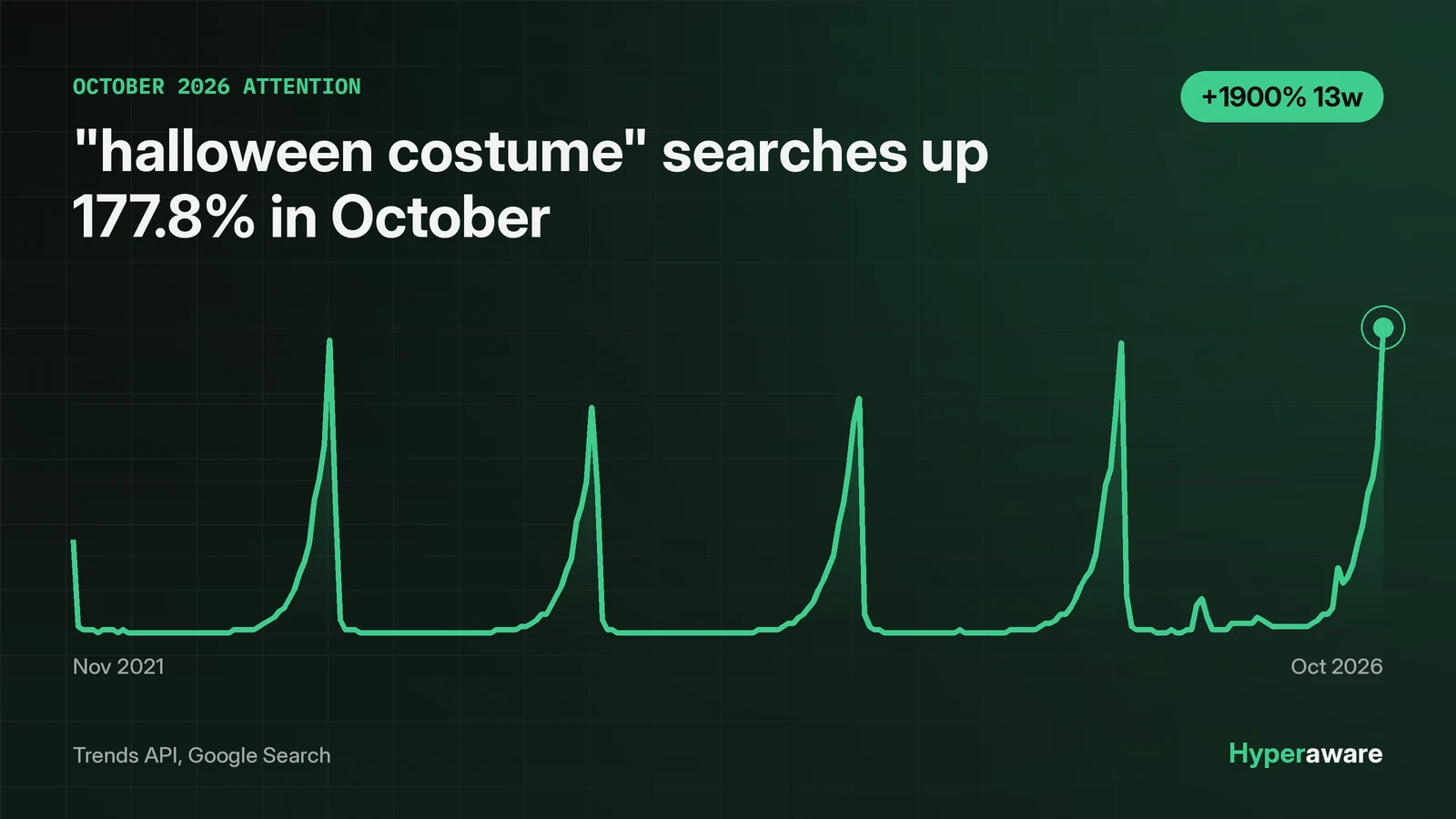
October 2026 belonged to Halloween, a baseball championship, and Patrick Stewart. Google Search interest in "halloween costume" rose 177.8% between October 3 and October 31, search interest in "world series" rose 571.4% in the same window, and "patrick stewart" became the single most-searched topic on Google's 30-day board after news of his death at 86 was reported on October 29. Those three spikes, measured from the Trends API on November 2, frame a month where entertainment attention followed the calendar and then the news.
Halloween owned October search
Search interest in "halloween costume" rose 177.8% from October 3 to October 31, hitting 100 on Google's index, the peak of the series. "pumpkin" followed at 97.9% growth, from 48 to 95. The effect was measurable across platforms, not just Google. TikTok's #costume hashtag climbed 66 ranks to #131 over the 30 days to November 2, and Pinterest's 30-day board was led by "fall nails", "halloween nails", "pumpkin carving ideas" and "pumpkin painting ideas", with "couples halloween costumes" at #10. YouTube's 30-day trending board was topped by a Halloween songs compilation.
The horror films rode the same wave. "Scream movie" search interest rose 112.5% in October. On IMDb's MOVIEmeter, Scream (1996) climbed 70 ranks to #23, The Nightmare Before Christmas (1993) climbed 65 to #16, and Hocus Pocus (1993) rose 45 ranks to reach #5. Casper (1995) climbed 51 ranks to #41, and Hereditary (2018) gained 47 to reach #52. The attention was seasonal and predictable: Hocus Pocus (1993) moved back into the top 10 on calendar momentum alone, while The Nightmare Before Christmas (1993) rose to #16.
The Brewers' first title drove a 571.4% search spike
Search interest in "world series" rose 571.4% from October 3 to October 31. The Brewers closed out the Rays in Game 5 for the franchise's first World Series title, according to ESPN's October 26 coverage, which the Trends API's news index matched with 42 articles across 14 outlets. The final week of the month also showed up on X's 7-day trending board, where "Dolphins" jumped 48 ranks to #46 on football conversation while the baseball news cycle shared the timeline with NFL Sundays.
A film put Elizabeth Holmes back in the search box
Elizabeth Holmes climbed 75 ranks to #10 on Wikipedia's 30-day trending board, while You Can See Everything, the film about her, climbed 127 ranks to #19. The news index carried 9 articles from 9 outlets about the film in the week to November 2. The same board showed the month's other film-driven mover: Obsession (2025 film) rose 131 ranks to #22. Two film-driven spikes, both visible as Wikipedia research traffic: one biographical, one horror.
The month's most-searched name was Patrick Stewart
"patrick stewart" ranked #1 on Google's 30-day trends board, ahead of "native american heritage month" and "martha stewart halloween costume". The spike followed news of Stewart's death at 86 on October 29, covered by 22 outlets including the Associated Press, CNN and The New York Times. The same week's coverage connected the story to his role as Professor X in the upcoming Avengers: Doomsday, whose new teaser breakdown sat at #2 on YouTube's 30-day board.
TikTok's strangest riser was #cornell7
TikTok's #cornell7 hashtag climbed 116 ranks to #69 over 30 days, the largest hashtag climb on the board, with #cornelluniversity rising 68 ranks to #47 alongside it. The news index tied Cornell to an October 29 announcement about an agreement with New York State Police on sexual assault investigations, covered by 11 outlets including Reuters. No single explanation accounts for a 116-rank climb on TikTok, and the data does not prove causation, but the timing lines up. Elsewhere on the board, #tiktokshopblackfriday rose 50 ranks to #100: the board's first sign of holiday shopping content arriving in October, and Google searches for "black friday" rose 200% in the same month.
The shopping apps are already competing for December
App Store free-app movers for the two weeks to November 2 read like a holiday preview. Capital One Shopping rose 44 ranks to #26 and Capital One Mobile rose 34 ranks to #6, while Partiful, the party invite app, rose 47 ranks to #35. Lyft climbed 41 ranks to #11 and the Waymo app rose 22 ranks to #68. Waymo's move coincided with news that Toyota and Waymo will test the bZ4X in Japan in 2027, carried by 10 outlets including Reuters. Uber rose 17 ranks to #8. The two-week changes are modest compared with Halloween's seasonal surge. Read as a holiday-shopping signal, this is inference from app rank movement, not spending data, but the direction is consistent across six different apps.
Prediction markets were already voting
Polymarket's 30-day board was dominated by the 2026 midterms: four of the top five were "Which Senate Swing States will Republicans win?", "Balance of Power: 2026 Midterms", "Which party will win the House in 2026?" and "Which party will win the Senate in 2026?" Haley Stevens topped Wikipedia's 30-day board after her Senate endorsement news cycle. October's two attention pools barely touched: prediction markets watched the 2026 midterms while search traffic watched sports and Halloween.
What the data does not show
Reddit's hot posts, YouTube trending, Pinterest, Polymarket and GitHub had no items in both the baseline and current snapshots, so no rank changes could be computed for those boards. YouTube's, Pinterest's and Polymarket's current leaders are recorded above, but not their movement. Reddit's snapshot is also the oldest in the set, from October 27. And every spike here is a measure of attention, not of sentiment: the data says what moved, not whether the world approved of it. November's boards will tell whether any of this outlasted the calendar.
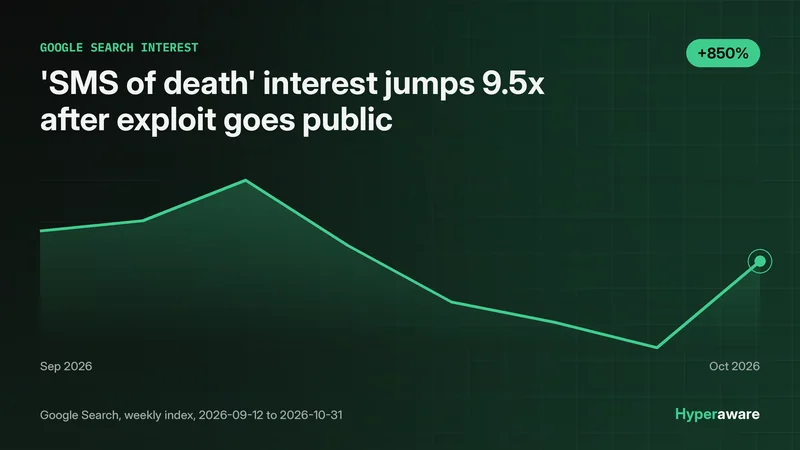
October was also the month the Android "SMS of Death" exploit drew security attention; read the news desk for the stories the data only hinted at.